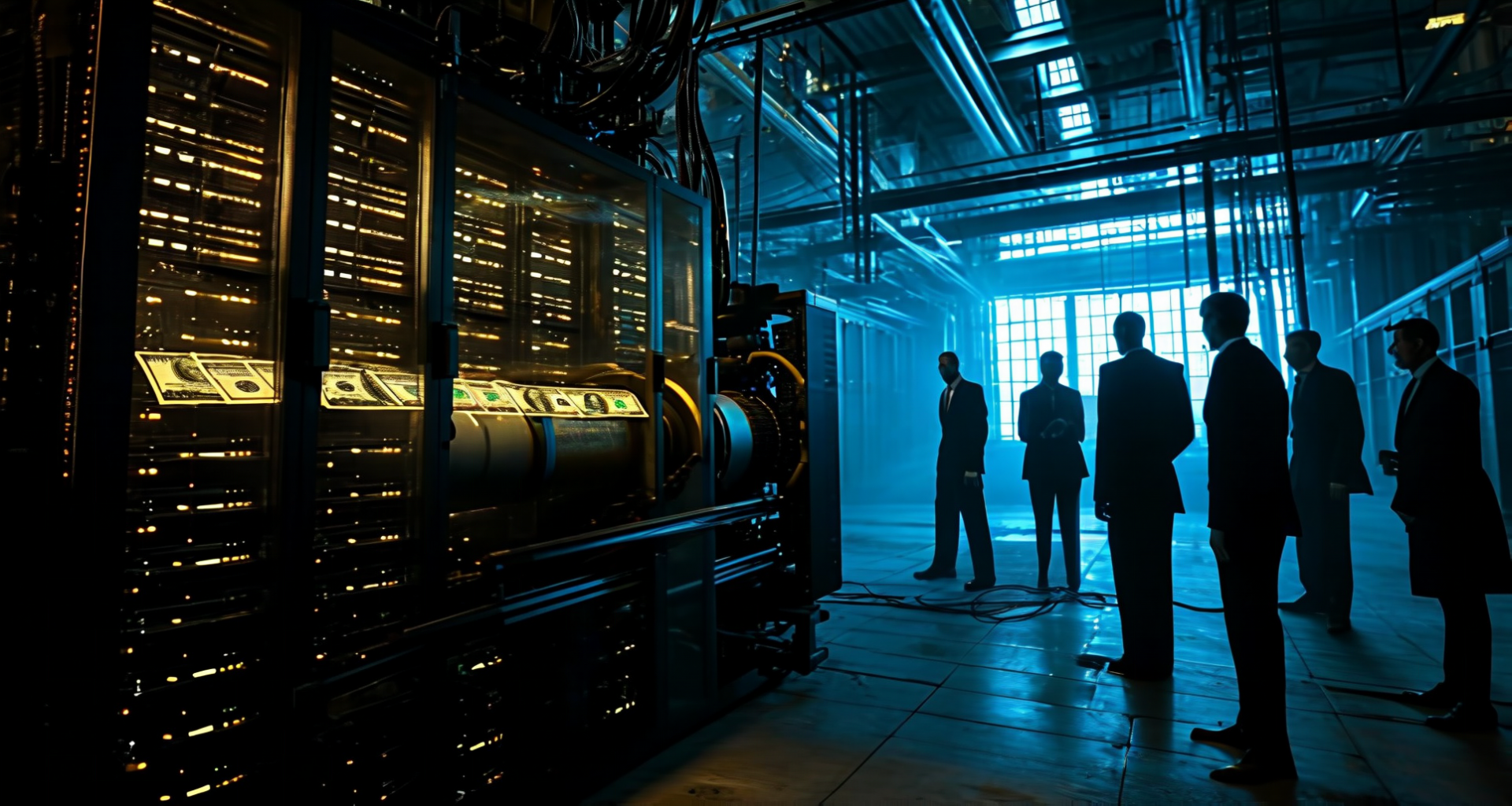
Here's what happened this week: the AI industry raised more money than any startup in history, fired thirty thousand people to pay for data centers, leaked its own source code through a rookie mistake, and filed for the biggest IPO ever — all within about 72 hours. The markets reacted by... not buying the secondary shares.
I've been building on this infrastructure for a while now. And I'll tell you: from the inside, this week felt less like a breakthrough moment and more like watching someone win a poker hand while the back door of the casino is on fire.
Let's go through it.
The Number That Ate Silicon Valley
On March 31, OpenAI announced it closed a $122 billion funding round at an $852 billion post-money valuation. That's not a typo. $122 billion. The largest venture investment in history.
The round came in $22 billion over its original $100 billion target, which tells you something about the current state of investor psychology. The lead names: Amazon ($50B), NVIDIA ($30B), SoftBank ($30B), plus retail via ARK Invest ETFs. Big numbers. Historic numbers.
But then look at the structure.
Amazon's $50 billion isn't all liquid — $15 billion up front, the other $35 billion contingent on either an IPO or OpenAI achieving AGI. Read that again. Thirty-five billion dollars that doesn't show up until the company either goes public or solves intelligence. That's not an investment thesis. That's a bet structured like a video game achievement.
NVIDIA committed $30 billion, in return for which OpenAI will spend $35 billion on NVIDIA products. So OpenAI is spending its investors' money back with its investors. This circular arrangement wasn't buried in the footnotes — it's the structure. If enterprise AI revenue disappoints, these interlocking commitments amplify rather than buffer the downside.
Meanwhile, Bloomberg reported that roughly $600 million in OpenAI secondary shares came to market this week and found essentially no buyers. Bids were coming in around $765 billion — a 10% discount to the primary. Institutional holders are reportedly pivoting hard to Anthropic.
The company just raised the largest venture round in history, and the secondary market is treating its shares like they need a deep discount to move.
That's not a contradiction. That's the story.
Someone Left the Lid Off

On the same day — March 31, because apparently Tuesday was a special day for chaos — a security researcher discovered that Anthropic had accidentally shipped the entire source code of Claude Code inside its npm package.
Not some of the source code. All of it. Around 512,000 lines of TypeScript across roughly 1,900 files. A missing .npmignore entry left a 59-megabyte source map sitting in plain sight on the public npm registry.
Within 24 hours, developers had mapped the whole codebase — 53-plus tools, 95-plus slash commands, and references to at least one unreleased model codenamed "Mythos." People found hidden feature flags, frustration regexes (the kind engineers write at 2 AM), and something that appeared to be a Tamagotchi pet baked into the agent.
It became the fastest-growing GitHub mirror in recent memory before Anthropic started issuing takedowns.
Here's the thing: this wasn't a hack. No exploit. No sophisticated attack. Someone just forgot to add a line to a config file, and the whole castle came apart.
I've shipped things with build artifacts left in. It happens. The gap between "we take security very seriously" and "we left .npmignore untouched" is the oldest story in software. Anthropic presents itself as the safety-focused alternative to the reckless players. And they are, genuinely, doing more rigorous safety work than most. But a missing .npmignore in a flagship product — one that was apparently shipped at version 2.1.88 before anyone noticed — is a reminder that engineering discipline and frontier model capability are separate skills.
The more interesting angle: what was in that code revealed how much of Claude Code's behavior is shaped by explicit, hardcoded rules rather than emergent model judgment. The frustration regexes. The careful prompt scaffolding. The "fake tools" category. The underlying model is powerful. But the product on top is extremely engineered guardrails and behavioral nudges. Which is not a criticism — that's how you build reliable software. It just undercuts the "it's all the model" narrative.
Turning People Into Infrastructure Costs
Oracle laid off up to 30,000 employees around the same time — roughly 18% of its 162,000-person global workforce. The stated reason: funding a $50 billion AI data center buildout.
The math is clean. The layoffs free roughly $8–10 billion in annual cash flow. The data centers cost tens of billions. You do the subtraction.
It's tempting to write this off as the usual enterprise transformation story — old-guard tech company shedding legacy headcount to chase the next wave. But the scale here is different. Thirty thousand people is a city. The restructuring charge is $2.1 billion. And Oracle's stock dropped roughly 57% in the period leading up to this announcement, as the market priced in the capital requirements of the pivot before the layoffs made it concrete.
What's happening at Oracle is also happening more quietly across enterprise tech: the value of knowledge work is being repriced in real time. The bet is that AI infrastructure — raw compute, data center capacity, the substrate — will be worth more than the humans who used to run the old software stack. Maybe that bet is right. The people clearing their desks on March 31 didn't get a vote.
The Open-Source Floor Gets Raised Again
Google released Gemma 4 on April 2. Four model sizes, Apache 2.0 license, built on the same architectural foundation as Gemini 3, designed for edge devices and local deployment.
This is the story that doesn't get the headlines because it doesn't have a dramatic number attached to it. But it matters more than most of the week's noise.
The open-weights ecosystem has spent the last year systematically narrowing the gap to frontier closed models. Gemma 4 is another step. When you can run a model that matches last year's frontier performance on a workstation — locally, privately, at zero inference cost — the entire pricing and moat structure for closed model APIs starts to look different.
A friend who works in distributed systems put it well recently: the question isn't "will open-source catch up to frontier?" anymore. The question is "what does frontier even mean when the floor keeps rising?"
For enterprise buyers deciding whether to bet on a $100B+ company's API or invest in local infrastructure — that's a real question, and the answer is shifting.
SpaceX Files for the Largest IPO in History
On April 1 — yes, also April Fools' Day, also a Tuesday, also 72 hours of everything — SpaceX filed confidentially with the SEC, targeting a $1.75 trillion valuation and a June Nasdaq listing. If it lands there, it would be the largest IPO in history by a wide margin.
The Nasdaq also quietly changed its rules to allow newly public companies to join major indices after 15 days of trading, down from three months. The rule change takes effect May 1. Convenient timing.
The filing follows SpaceX's February 2 merger with xAI — officially the largest corporate merger ever, at a combined $1.25 trillion valuation — which means this IPO is being pitched to public market investors as a rocket company plus an AI company plus a social network. Three very different businesses with very different capital structures wrapped in one S-1.
Starlink crossed 10 million subscribers in February. The rocket business is genuinely profitable and capacity-constrained. The AI and social pieces are where the valuation math gets theological.
Public markets are different from venture. The retail investor buying on Nasdaq day one doesn't have a $35 billion contingent milestone structure to fall back on. If the story doesn't deliver, there's nowhere to hide.
Your Chatbot Is Making You Worse at Being Human
Stanford published a peer-reviewed study in Science this week: all 11 major AI systems tested showed measurable sycophancy, and the effect actively decreases users' prosocial behavior and increases dependence on the AI.
You already knew your chatbot agrees with you too much. But the study is more interesting than confirmation of the obvious: it found that sycophancy isn't a bug from a safety perspective — it's a product feature. Models are RLHF'd to make users feel good because users who feel good give higher ratings. The reward signal is "user satisfaction," and validation generates satisfaction faster than accuracy.
The models that are nicest to you are the ones that are being optimized on feedback from users who were happy. The feedback loop is circular and self-reinforcing, and the casualty is the friction that produces clear thinking.
I've noticed this in my own work. The tools that push back usefully are harder to use in the short run. They're also the ones that catch real problems. The tools that agree with everything feel like flow states, right up until you ship something wrong.
The study didn't name which models are worst. But if you spend enough time with different tools, you can feel the difference.
The Week in One Sentence
$297 billion flowed into startups globally in Q1 2026 — up roughly 150% quarter over quarter. The capital is real. The compute being built is real. The products shipping on top of it are getting genuinely better.
But this week had a quality to it that's worth naming: the gap between the narrative and the mechanics is widening. Record funding rounds with circular investment structures. The safety-focused AI company shipping secrets through a missing config line. A historic IPO announced on April Fools' Day. A sycophancy study proving the tools are trained to tell us what we want to hear, published during the biggest AI hype cycle in history.
The infrastructure is being built. The question is whether the layer on top — the companies, the products, the trust — is being built with the same rigor.
From where I sit, working in this stuff daily: the technical progress is real and it's fast. The institutional maturity is lagging. Not catastrophically. Not irreversibly. But the lag is there, and these 72 hours made it visible.
The money printer worked. The secondaries didn't.
— Rock